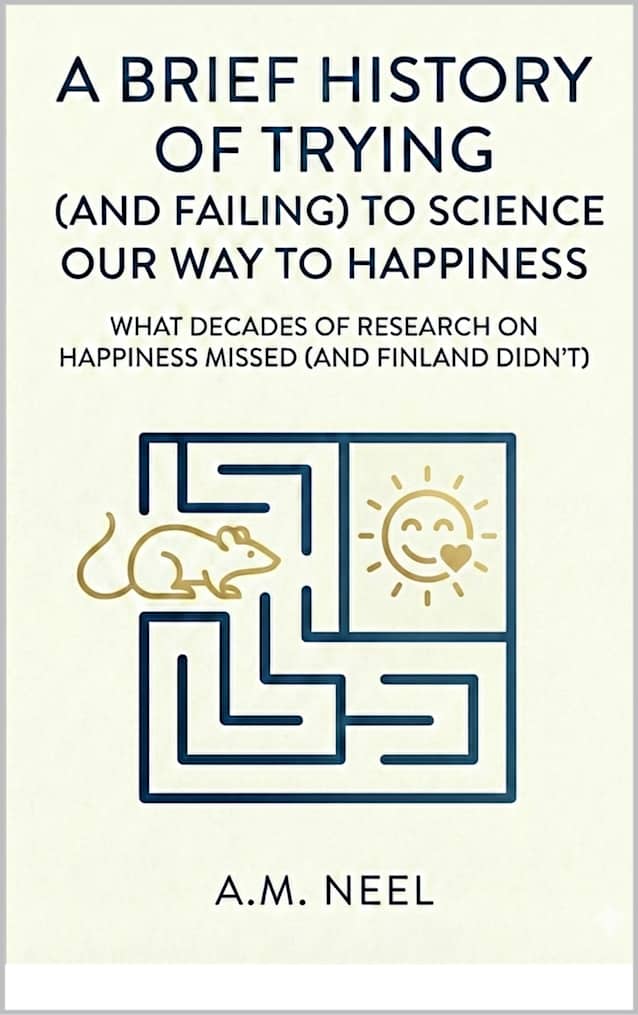
A Brief History of Trying (And Failing) to Science Our Way to Happiness: What Decades of Research on Happiness Missed (And Finland Didn’t)
About
The Finns rank #1 in life satisfaction by sitting at home in their underwear not trying to be happy. Americans rank 15th-20th while constantly pursuing happiness through optimization and self-improvement. This suggests something important about whether trying harder actually works.
After decades of happiness research, here’s what science has learned: pursuing happiness directly doesn’t work and often backfires. Roughly 50% of your happiness is genetic and you probably can’t change it. Most interventions produce small, temporary effects. The things that actually matter (social connection, meaning, comprehensive social support) aren’t things you can just decide to have. And even if you could change everything, you’d adapt back to baseline within months.
This is not the kind of book that promises to make you happy. It’s the kind that explains why that promise is impossible to keep.
A Brief History of Trying (And Failing) to Science Our Way to Happiness is a darkly funny, rigorously researched tour through decades of happiness science—from lottery winners who returned to baseline, to meditation monks with 50,000 hours of practice, to the World Happiness Report that crowned Finland #1 despite a culture built on not expecting to be happy.
Through the stories of the researchers who studied happiness (and were often miserable themselves), you’ll discover:
- Why Philip Brickman’s lottery winner study proved the hedonic treadmill is real—then killed himself at 38 when that knowledge couldn’t save him
- Why money buys happiness to a point—except when it doesn’t, depending on which study you believe
- Why your brain has a dopamine system designed to create wanting without satisfaction—keeping you permanently unsatisfied
- Why positive psychology’s interventions mostly don’t work—despite promising you could increase happiness through gratitude journals
- Why being too happy can be as dysfunctional as depression—according to research on manic patients
- Why Viktor Frankl survived concentration camps through meaning, not happiness—and why pursuing happiness directly leads to existential vacuum
- Why the Finns topped the World Happiness Report for 7 years straight—by not pursuing happiness, accepting that life is hard, and building comprehensive social support
The research is clear: you can’t optimize your way to lasting happiness. The more you pursue it, the more it recedes. The harder you try, the worse it gets.
So what should you actually do?
Lower your expectations. Stop trying so hard. Accept that life is difficult and good enough is actually good enough. Invest in relationships. Find meaning in something beyond yourself. Advocate for better social systems. And occasionally sit at home in comfortable clothes doing nothing productive, because sometimes that’s exactly what you need.
This isn’t inspiring advice. It won’t sell meditation apps or self-help courses. But it’s what the research actually supports—presented with the honesty it deserves and none of the false promises.
Written by someone researching happiness while going through divorce and depression, this book practices what it preaches: honesty over hope, acceptance over optimization, and recognition that sometimes the best you can do is just get through another winter.